Friday, March 5, 2010

Real Threat or Masterfully Formulated Justification for Invasion?


The International Atomic Energy Agency, the UN's nuclear watchdog institution, received a letter from Iran detailing plans to enrich its uranium stockpile. Secretary of Defense Robert Gates said that the US had done all it could to entince Iran to negotiate. Now, the US, France, and even Russia are calling for stronger sanctions. Konstantin Kosachyov, head of the foreign affairs committee in the lower house of the Russian Parliment, said that it is time to prepare the international community for "serious measures."

Though Iran claims that this uranium will be used in medical reactors (whatever those are), international leaders are skeptical. According to the Federation of American Scientists, "Uranium gun-assembled weapons are the easiest to build. The acquisition of significant quantities of U-235 or a facility in which to seperate the fissile material is an indicator that the acquiring state could be in the process of gaining a rudimentary nuclear capability." Despite this, it is still possible that Iran's nuclear ambitions are peaceful. It should be kept in mind that uranium must be enriched to 90% to be used for nuclear weapons. Nuclear reactors have many other uses, like alternative energy and whatever the heck that medical business is. But does Iran really seem interested in being a leader in the fight against climate change or pioneering medical breakthroughs? Considering how vocal Achmadenijawhatever has been about his less-than-glowing opinion of Isreal and the West, that's not likely.

Wednesday, March 3, 2010

This isn't really news...


Shon Hopwood was a crappy bank robber, but apparently he's a pretty good Supreme Court practitioner. Though he doesn't have a law degree or any formal training, he spent basically a decade in a prison law library. In 2002, he prepared his first petition for certiorari for a fellow inmate. Of the 7,209 petitions the court received that year, Hopwood's was one of the eight heard. Some lawyer guy read his petition and decided to take the case for free. They talked about the best way to make a guilty person appear innocent and whatever else lawyers talk about. In 2004, they won. Hopwood plans on applying to law school next year. Richard Friedman, Professor of Law at the University of Michigan, has already talked to admissions about saving a spot. What an American dream.

Tuesday, March 2, 2010

Do Ask, Do Tell


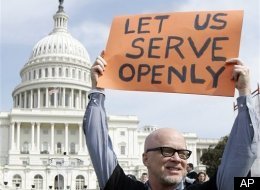
Every year, 1000 men and women are kicked out of the military for being gay. Today, Defense Secretary Robert Gates and Chairman of the Joint Chiefs of Staff Admiral Mike Mullen will meet with Senate Armed Services Committee to discuss halting this discrimination.

Homosexuality has always been persecuted in the American military. In 1993, President Clinton began the fight to allow openly gay men and women into the military. His efforts, however, only established the current policy, which was still a significant accomplishment. But as American society as a whole has become more open to the LGBT community, it seems tragically archaic and contradictory to our established values. Ending the ban was one of Obama's many major campaign promises that he reaffirmed in his State of the Union. Lifting this ban would be a tremendous step to ending discrimination against the LGBT community.

But opposition is strong. Tony Perkins, president of the conservative Family Research Council, argued, "Our service members wear the uniform to fight and win wars, not serve as liberal-social-policy guinea pigs. The sexaul environment the President is trying to impose upon the young men and women who serve this country is the antithesis of the successful war-fighting culture, and as such should be rejected." Apparently, Mr. Perkins has forgotten about the most cliche pillar of the conservative value system: Live and let live. Even if you do believe that homosexuality is the "antithesis" of the war aspect of our culture, I would argue that institutionalized discrimination is the antithesis of every aspect of our culture. Sanctioning discrimination against one group inevitably leads to discrimination against others. Gates, Mullen, and Obama seem to agree.

Lifting the ban would be a challenge. If Gates and Mullen are not successful in lifting it entirely, they at least hope to lessen its impact and prepare the way for the eventual overturning of the policy. However, the president and democratic leaders seem happy to allow the proposal to languish for at least a year- as neither view it as a political win.


Friday, January 29, 2010

Obama in the House


Only two days after his state of the union, Obama met with House Republicans to discuss areas of partisan conflict, saying, "I'm a big believe not just in the value of a loyal opposition, but in its necessity." He fielded questions about health care refrom, economic policy, and who is really to blame for the rise in partisan politics. In a rare occurence for American politics, the president debated with a stiff opposition for an hour and a half, even directly engaging Republican leaders. Seldom are events such as this made public and Republican strategists were concerned that televising the event might give Obama the upper hand- considering his skill in such situations. However, even in a toxic political climate, the debate was substantive and civil. Though neither side acquiesced much in terms of policy, both reaffirmed their commitment to working together in the coming years. Obama plans to hold monthly meetings with Republican and Democratic leaders to work through issues and incorporate both sides in developing solutions.

http://thecaucus.blogs.nytimes.com/2010/01/29/obama-house-repulicans-debate-their-division

C-SPAN has the meeting archived:
http://www.c-span.org/

Wednesday, January 27, 2010

State of the Union


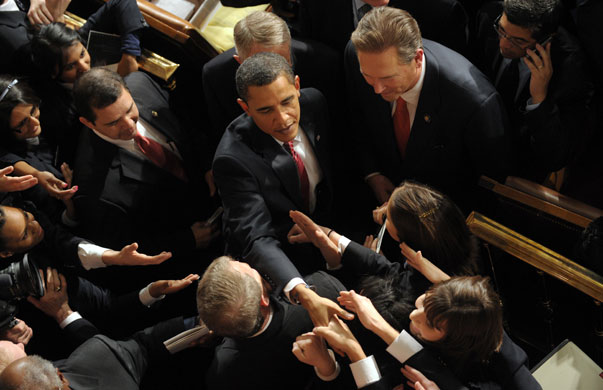
Though I'm sure people will, I think it would be hard to argue that Obama's address was anything less than excellent. He addressed essentially every major political issue, from creating jobs and regulating banks to making college affordable and reducing our nuclear stock pile. Critics have said that he tried to talk about too many issues, but, of course, they would have attacked him for leaving something out. Another interesting criticism is the fact that he didn't put healthcare first. However, I took that as a sign that he's listening to the American people and adjusting his policy agenda accordingly. He understands that health care reform isn't the biggest issue in the minds of the typical citizen- the economy is. Everything he addressed before health care- apart from education- had to do with the economy. Instead of criticizing this, we should welcome it as a sign that Obama is going to adjust his priorities to more closely match Main Street's.

My favorite proposals:
Job creation through public service employment to improve and green national infrastructure (it's so 1930s)
Passing a comprehensive clean energy and climate bill (which could also facilitate job creation and establish the US as a global leader for environmental sustainability)
Encouraging the decrease of college tuition
Reducing our nuclear stockpile and securing stray nuclear material
Requiring all earmarks to be published (if it's well enforced, I imagine it will drastically decrease them)
Creating a bipartisan fiscal commission (executive orders make for interesting politics)


Monday, January 25, 2010

I'm Ben Bernanke, Spencer.


It's no longer clear if the Senate will confirm Ben Bernanke (Obama's pick) for a second term as the chairman of the Federal Reserve. Brown's victory in Massachusetts exposed public upset at policies that bailed out big banks but failed to decrease unemployment. Bernanke, in the minds of most Americans, is a symbol for those policies. During the crisis, Bernanke promoted unorthodox policies to avoid another depression. However, both before and now after the crisis, he has become conventional and complacent. So, by not confirming Bernanke, the Senate would be responding to the public's disdain of his policies and failure to create new ones to stabilize the economy. However, it could be argued that Bernanke's failure to create new policies is a response to the public's disdain for government regulation.
Equal paradoxically, even if Bernanke isn't the best choice, he's still the best choice. Any good alternative would be badgered to death by the Senate and any bad alternative could potentially destroy the economy. Bernanke may not be doing much now, but he knows whats going on. He is an established politician as well as a revered economist. He knows how to handle the commission and direct internal discussion, things that his colleagues could not handle.
The best course of action would be to confirm Bernanke, but let him know that we're not satisfied.


Thursday, January 21, 2010

Deficit


As he attempts to pass reforms to stimulate the economy, Obama faces an insurmountable foe: the rising deficit. Obama's agenda includes many sweeping reforms that could stimulate and stabilize the economy, but every debate comes back to cost. Republicans and democrats alike are wary of passing policy that would increase the burden on taxpayers- particularly with the upcoming elections. And taxpayers are thankful. However, at the same time Americans are expecting tax breaks and cuts in government spending, they are also expecting the government to do something about unemployment and inflation. Tackling the deficit means cutting government programs and raising taxes. But funding government programs means increasing the deficit and raising taxes. In his State of the Union, Obama is expected to propose bigger deficits now, with a promise for more budget discipline later.